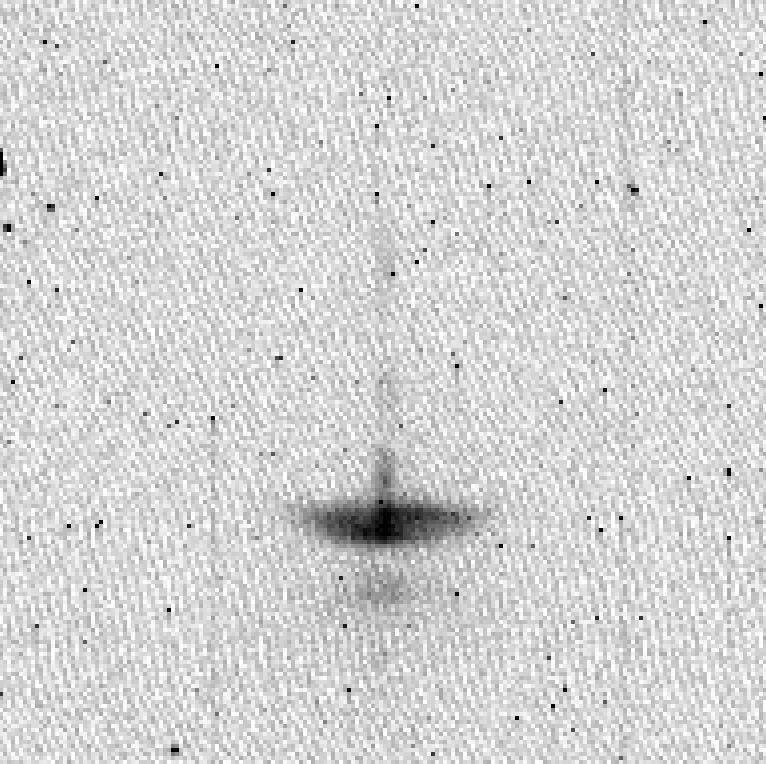
|
When STIS resumed operations in July 2001 using the redundant "Side-2"
electronics, the read-noise of the CCD detector appeared to have increased
by ~1 e− due to a superimposed and
highly variable "herring-bone" pattern noise. For many programs that aim to
detect signals near the STIS design limits, the impact of this noise is far
more serious than implied by a mere
1 e− increase in the amplitude of the
read-noise, as it is of a systematic nature. Peak-to-valley deviations on
spatial scales of only a few pixels can be as large as
~8 e−.
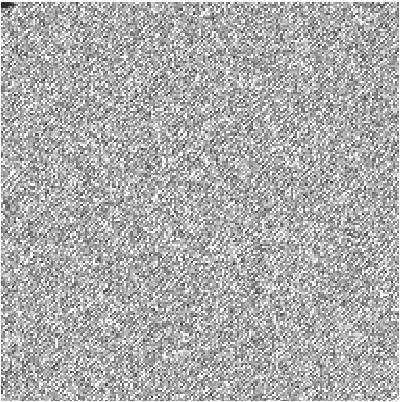
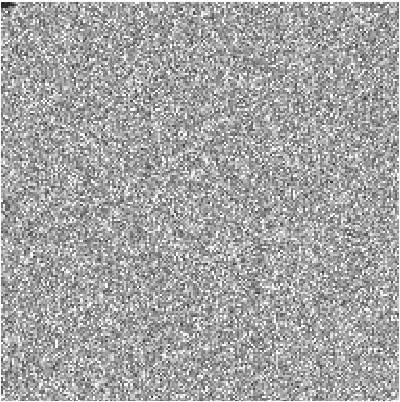 Example — [left] A portion of a raw, gain=4 BIAS frame o6hn4x020,
taken in 2002 February; [middle] the pattern-free cleaned version available
here; [right] move your cursor over the image to blink between the original
and pattern-free frames. The pattern noise is even more apparent in gain=1
frames.
Example — [left] A portion of a raw, gain=4 BIAS frame o6hn4x020,
taken in 2002 February; [middle] the pattern-free cleaned version available
here; [right] move your cursor over the image to blink between the original
and pattern-free frames. The pattern noise is even more apparent in gain=1
frames.
We perfected a method to cleanly and robustly detect and remove this
pattern-noise from raw STIS CCD frames
(Jansen, Collins & Windhorst 2002). After removal of the pattern noise,
we successfully reproduce the nominal "Side-1" CCD read-noise as observed prior
to 2001 July. As part of an approved Cycle 16 Archival Calibration
Legacy program (AR 11258; PI: Rolf Jansen) we removed the pattern noise from
all 75345 raw, un-binned, full-frame "Side-2" STIS/CCD frames (47192
datasets) taken between 2001 July and the short that rendered STIS inoperable
early in 2004 August. A more detailed paper describing the method, the nature
of the noise, and trends therein over time is
Jansen et al. 2010 (in: 'The 2010 STScI
Calibration Workshop', Eds. S. Deustua & C. Oliveira, [STScI;
Baltimore], pp.449–455 ).
In Fall 2012, Jansen also removed the pattern noise from all 30584 raw,
un-binned, full-frame "Side-2" STIS/CCD frames (12958 datasets) taken between
2009 June 2 and 2011 October 31, i.e., presently public data taken after the
repair of STIS during the final HST Servicing Mission
(Jansen 2013, AAS#221 [344.11]).
 Unbinned subframe-readout
"Side-2" STIS/CCD data, i.e., with 1060×N for even N ≥ 16
pixels, is now also supported. For the smaller (≤ 256 pixel) formats, one
should expect only partial removal of the pattern noise (since there is much
less information in the frequency power spectrum). Nonetheless, a marked
improvement over uncorrected data was demonstrated. Unbinned subframe-readout
"Side-2" STIS/CCD data, i.e., with 1060×N for even N ≥ 16
pixels, is now also supported. For the smaller (≤ 256 pixel) formats, one
should expect only partial removal of the pattern noise (since there is much
less information in the frequency power spectrum). Nonetheless, a marked
improvement over uncorrected data was demonstrated.
Through this web-portal, users may search for and download pattern-free
datasets of interest (or, alternatively, pattern-only datasets) via a series of
index pages. In the future, we may support requests of all data for a given
observing program (Proposal ID) at once.
|